

Topics and Subtopics (wip)
Tech Note: We use Topics and Subtopics to implement a hierarchical structure that may include multiple levels, not just two. These terms are more descriptive and user-friendly than WordPress’s Categories and Subcategories, and are applied flexibly across levels. When discussing WordPress directly, we use its terminology, but the concepts are the same.
Introduction
This article explains the concepts of Topics and Subtopics, and how they are used to organize briefings and create short titles for briefings. Understanding this information is essential to properly assign briefings to a category and to create new subcategories that promote good navigation. Our approach is unconventional in how we sometimes use sub for short titles, as explained further down.
Note: the screenshots in this article show how they looked at the time they were taken. Because subcategories are fluid, what you see when you visit the website will likely vary, but the discussion of the concepts remains valid.
Topics organize briefings and define how they are grouped. They are hierarchical, with subtopics sitting within parent topics, refining them into more specific areas while remaining part of the broader grouping.
Where Topics Appear
Topics Panel
Assigned topics appear in a topics panel on the left sidebar of the home page and on all briefing listing pages, as shown in the screenshot below. On a mobile device, the topics panel will appear in a single column above the briefing list.
Notice that each topic is accompanied by either a list icon or a document icon, as will be explained shortly.
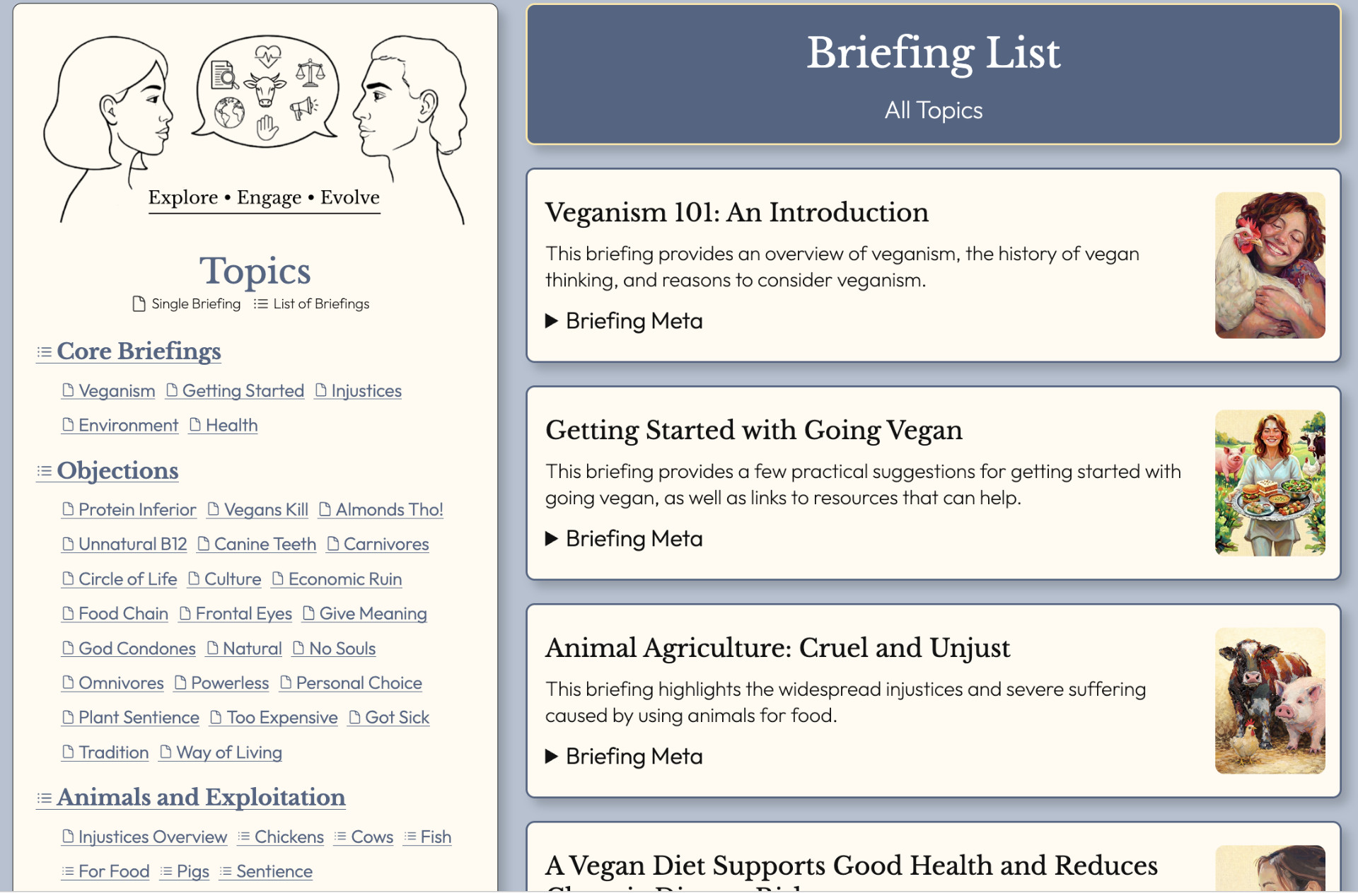
Clicking a topic or subtopic takes the user to a list of briefings assigned to it. If only one briefing is assigned to the topic or subtopic, the list will be bypassed, and the user will be taken directly to the assigned briefing.
Note that publishing a new briefing often requires creating new topics.
Breadcrumbs
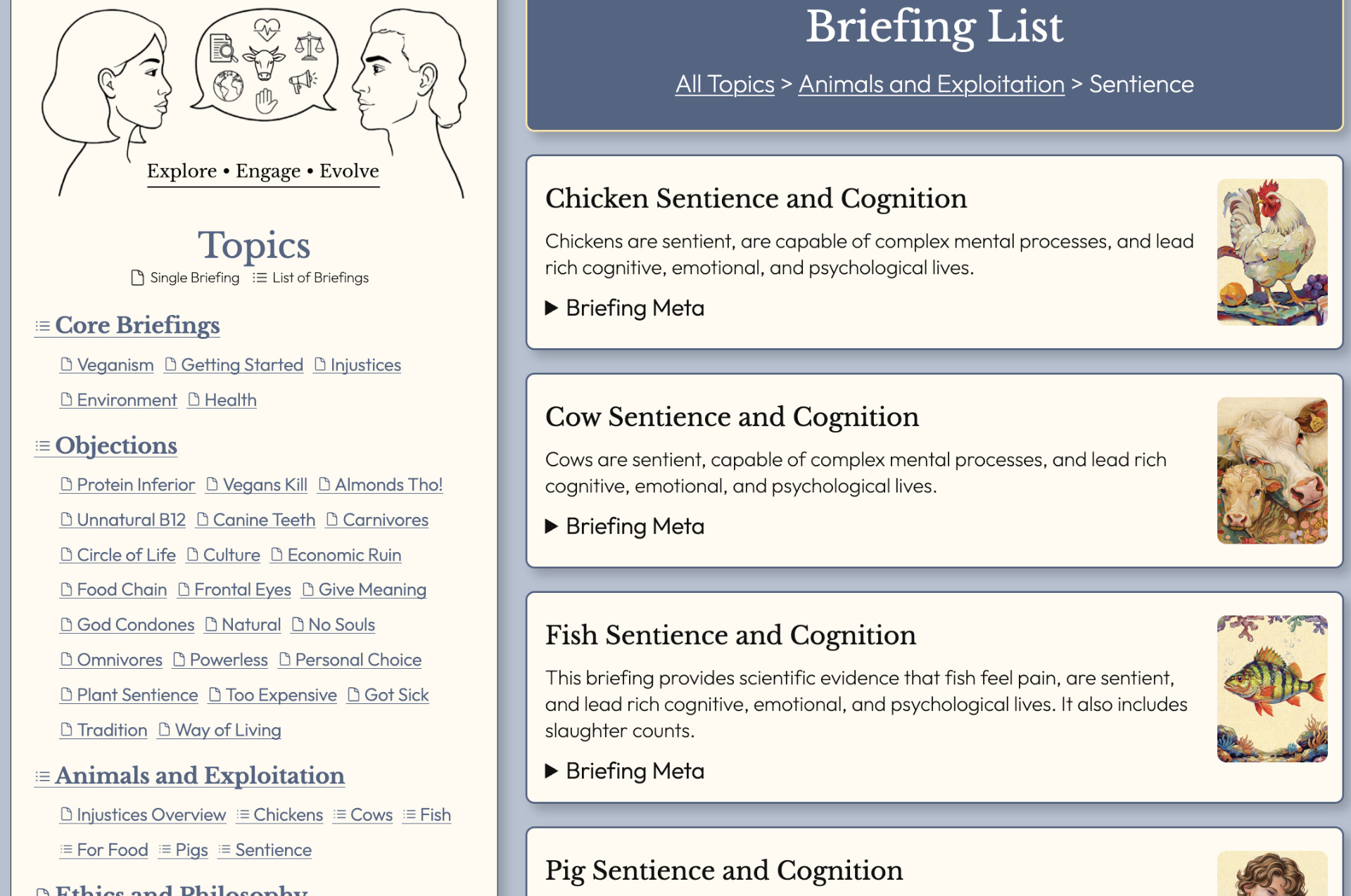
Topics also appear in “breadcrumbs,” which provide a navigational trail. To illustrate, if you click on “Sentience” under the top-level topic “Animals and Exploitation,” above, you will be taken to a list of briefings assigned to the topic “Sentience,” as shown below.
Notice that under the “Briefing List” title in the right column, the user now sees a clickable breadcrumb. “Sentience” is not clickable because the user is already viewing the sentience briefings list. Because “sentience” is a subtopic of “Animals and Exploitation,” you can click on “Animals and Exploitation” to get a list of all briefings in that topic, which is a top-level topic. Clicking “All Topics” takes you back to the homepage, where all topics are listed.
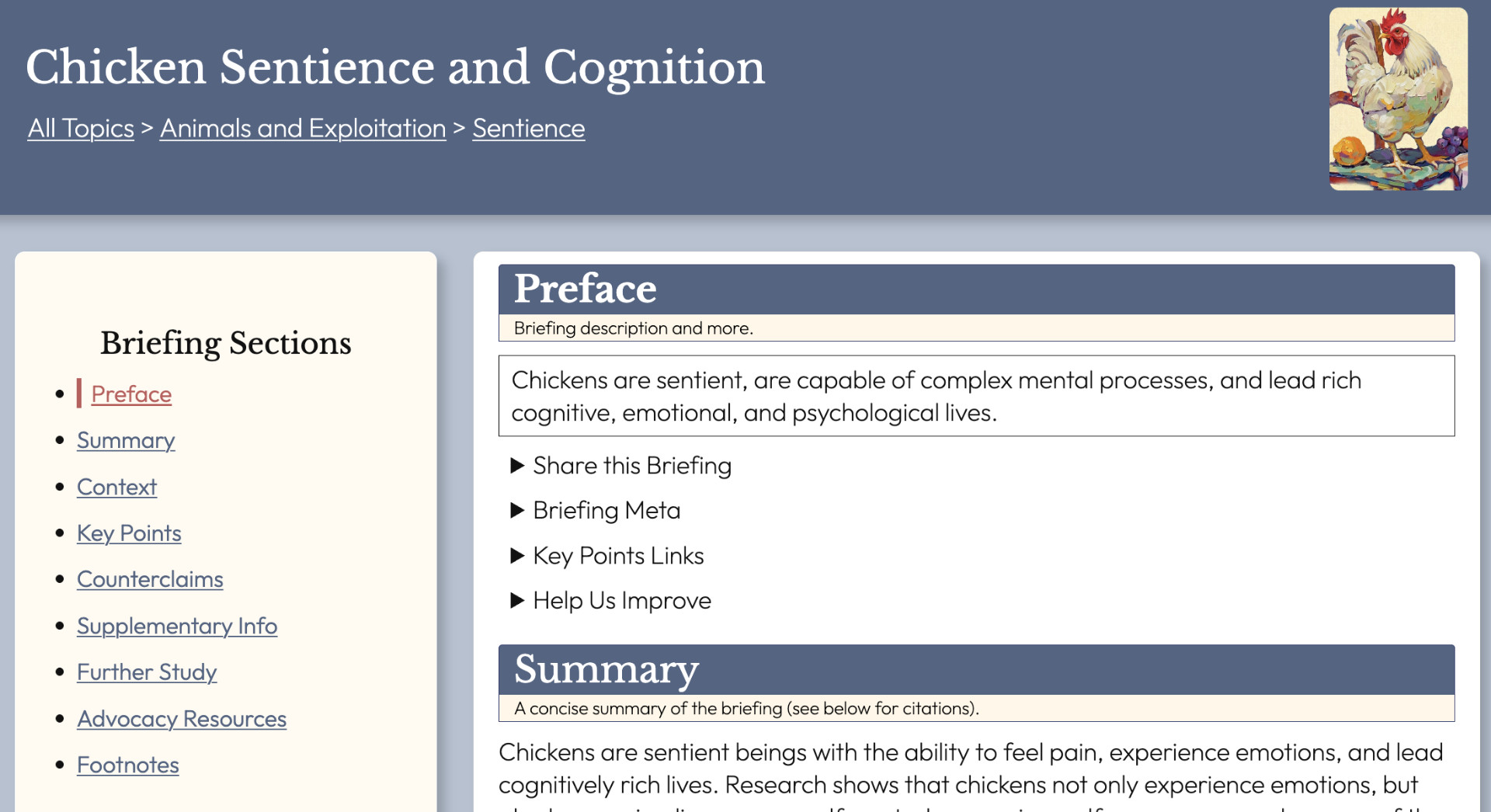
Breadcrumbs also appear on individual briefing pages, as shown in the following screenshot’s header. Notice that “Sentience” is now clickable, which takes you to a list of briefings for that subcategory.
List Icons vs Document Icons
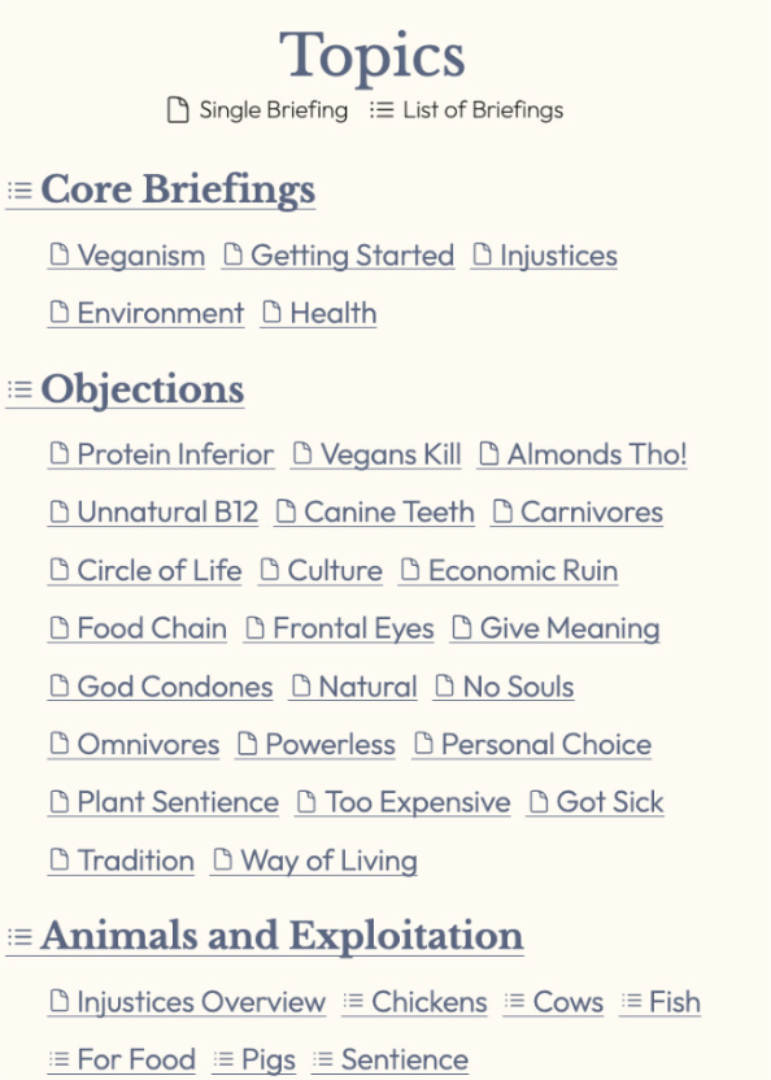
Notice that in the topics panel some entries have a list icon (e.g., Objections, Sentience), while others have a document icon (e.g., Veganism, Canine Teeth). Selecting an entry with a list icon opens a list of briefings for that topic, while selecting an entry with a document icon opens a single briefing.
Top-Level Topics
The following describes the top-level topics. Top-level topics should remain stable, as they form the foundation of the structure. Changes to this overall “tree” affect all subtopics beneath it. As new briefings are added over time, adjustments may be needed at the subtopic level to maintain clear and logical organization.
- Core briefings are foundational to understanding or practicing veganism. They often serve as entry points for those beginning to explore the topic.
- Objections examine common criticisms, questions, or challenges raised about veganism. Each briefing carefully analyzes the objection and presents well-supported responses grounded in evidence and reasoning.
- Philosophy and Society explores the ideas, belief systems, and social influences that shape how humans think about and treat animals. These briefings examine moral reasoning, philosophical perspectives, psychological tendencies, cultural norms, and religious viewpoints, helping readers think more deeply about issues of harm, responsibility, and justice.
- Animals and Exploitation describes how animals are used within various human industries and practices and examines the conditions they experience. This category also includes information about animal sentience and the scientific understanding of animals’ capacity to feel, perceive, and experience their environment, helping readers better understand the moral significance of animal use.
- Environment examines the environmental impacts associated with animal agriculture and related practices. Topics may include climate change, land use, biodiversity loss, water pollution, and resource efficiency, drawing on scientific research to explain these connections.
- Human Health explores the health implications of dietary patterns and food systems. These briefings examine scientific evidence related to plant-based diets, disease risk, nutrition, and public health considerations.
- Advocacy focuses on communication strategies and practical considerations for discussing veganism and animal ethics with others. These briefings provide guidance, framing ideas, and tools that can help make conversations more thoughtful, constructive, and effective.
Second-Level Topics (Subtopics)
Directly under the six top-level topics are the first-level topics or subtopics. Currently, there are only two levels, Top-Level Topics and Second-Level Topics (subtopics). As the number of published briefings grows, an additional level in the hierarchy may be useful. See the Topics Panel screenshot above to get a feel for this.
Most of the subtopics serve as short titles, but some are groupings. The reason for using subtopics as short titles will be explained shortly. The following table shows some representative examples.
| Topic | Subtopic | Purpose | Briefing Assignment(s) |
| Core | Veganism | Short Title | Veganism 101: An Introduction |
| Objections | Unnatural B12 | Short Title | B12 Information for Humans |
| Human Health | Protein | Short Title | Plant Protein: Abundant, Complete, and Healthier |
| Human Health | Nutrients of Concern | Grouping | Plant Protein: Abundant, Complete, and Healthier B12 Information for Vegans |
We will discuss assigning a briefing to multiple subtopics later, but for now, notice that both the B12 and Protein briefings are both in two different top-level topics.
Using subtopics for short titles is an unconventional use of hierarchical taxonomies and calls for explanation. It’s all about the ability to scan the Topics Panel and quickly find the desired one.
Imagine if, in the Topics Panel, the full titles of the Core Briefings and Objections were listed. This would make it difficult to scan and get to the briefing one was looking for.
Creating subtopics as short titles and/or assigning multiple subtopics to a single briefing can be done for three reasons, depending on the briefing.
- A single briefing may cover multiple topics, and thus needs multiple short titles.
- A single briefing may need to appear under more than one top-level topic.
- A short title be created because we don’t yet have enough briefings for a subtopic.
Each of these is discussed below in the context of the top-level topics. The six top-level topics—Core Briefings, Objections, Animals and Exploitation, Philosophy and Society, Environment, Human Health, and Advocacy—are fully described later in this article.
Core Briefings
Core briefings are foundational for understanding veganism and practicing veganism. For this reason, their number is intentionally kept small. To ensure direct access from the Topics Panel, each core briefing is assigned a concise subtopic serving as a short title.
The subject areas of the three core briefings covering the environment, human health, and animals & exploitation also exist as separate top-level topics with additional briefings providing more detailed coverage. This should become clearer in the table below.
The core briefings associated with these areas are included in both places:
- Under Core Briefings as foundational content
- Under their respective topic areas as overview briefings
This is illustrated in the following table, showing additional subtopic assignments for three of the five core briefings.
| Briefing Title | Top-Level Topic > Assigned Subtopic (Short Titles) |
| Veganism 101: An Introduction | Core Briefings > Veganism |
| Getting Started with Going Vegan | Core Briefings > Getting Started |
| Animal Agriculture: Cruel and Unjust | Core Briefings >Injustices Animals and Exploitation > Injustices Overview |
| The Environmental Impact of Animal Agriculture | Core Briefings > Environment Environment > Environment Overview |
| A Vegan Diet Supports Good Health and Reduces Chronic Disease Risk | Core Briefings > Health Human Health > Health Overview Human Health > Diets of Concern > Vegan Diet |
Objections Briefings
Briefings under the top-level topic “Objections” are likely to be assigned to multiple subtopics to provide multiple short titles. This is because one briefing may cover a group of related topics.
Examples:
| Briefing Title | Assigned Subtopics (Short Titles) |
| Nature-Based Objections to Veganism | Circle of Life, Food Chain, Natural, Predators |
| “Humans Are Omnivores with Canine Teeth and Front-Facing Eyes” | Omnivore, Canine Teeth, Carnivore, Frontal Eyes |
In order to keep related information together, sometimes an objection may be addressed in the Counterclaims Section of another non-objection briefing,
For example, the briefing “B12 information for Vegans” falls under the top-level topic “Human Health.”
Related to this topic, there is a common objection to veganism that “A vegan diet is not natural because vegans need to supplement with B12.” Rather than have closely related information in two separate briefings, we present the objection as a counterclaim in the first briefing, “counterclaims” being a standard section of briefings. This results in two topic assignments for “B12 Information for Vegans.” Both of these topic assignments serve as short titles, and fall under two different top-level topics, as follows:
| Briefing Title | Assigned Subtopics (Short Titles) |
| B12 Information for Vegans | Objections > Unnatural B12 Human Health > B12 Info |
When the user clicks on “Unnatural B12,” they are taken not to the top of the briefing but to where in the briefing that objection is addressed.
Other Top-Level Sections
A short title can be created because we don’t yet have enough briefings for a subtopic. We will use the Human Health top-level topic to illustrate this.
Currently, there are subtopics of Human Health that are not short titles, reflecting a hierarchy that will be more useful as more Human Health briefings are created, and introducing a second-level that does not consist of short titles.
At the time of writing or edit, the subtopics under Human Health look like this:
—Diets of Concern
——Vegan Diet (short title)
—Nutrients of Concern
——B12 (short title)
——Protein (short title)
—Diseases and Conditions
——Diabetes (short title)
—Public Health Issues
——Hunger and Starvation (short title)
—Other Health Topics
——(now empty)
The platform allows for assigning a briefing to multiple subtopics in the same family tree. This is not normally done, but in cases where we don’t yet have a lot of subtopics for a top-level topic, we can do this if there is more than one subtopic at the short title level.
For example, we have briefings on B12 and Protein, so we will assign those briefings to the appropriate short tille as well as “Nutrients of Concern.” Later, when we have published more briefings under “Nutrients of Concern,” we can optionally remove the assignments at the short-title level.
If there is only one briefing under a second-level subtopic, as is the case currently for Diabetes under “Diseases and Conditions”, the briefing should be assigned to the short title Diabetes, but not to “Diseases and Conditions” until we have at least two briefings under “Diseases and Conditions.” This is because the user would be surprised if they clicked on “Diseases and Conditions” and were taken to the Diabetes briefing.
When the second briefing under “Diseases and Conditions” is published, then both should be assigned to “Diseases and Conditions.”
Under these guidelines, the assignments look like this:
| Briefing Title | Assignment | Notes |
| A Vegan Diet Supports Good Health and Reduces Chronic Disease Risk | Core Briefings > Health Human Health > Health Overview Human Health > Diets of Concern > Vegan Diet | This core briefing also needs to appear in the topics panel under “Human Health,” because the user would expect it to be there. |
| B12 Information for Vegans | Nutrients of Concern B12 | Assigned to “Nutrients of Concern” because there is more than one briefing under “Nutrients of Concern.” |
| Plant Protein: Abundant, Complete, and Healthier | ||